BIZ-OMICS
Economics: IB Econ HL Paper 3 - The Maths Toolkit
Economics: IB Econ HL Paper 3 - The Maths Toolkit
Couldn't load pickup availability
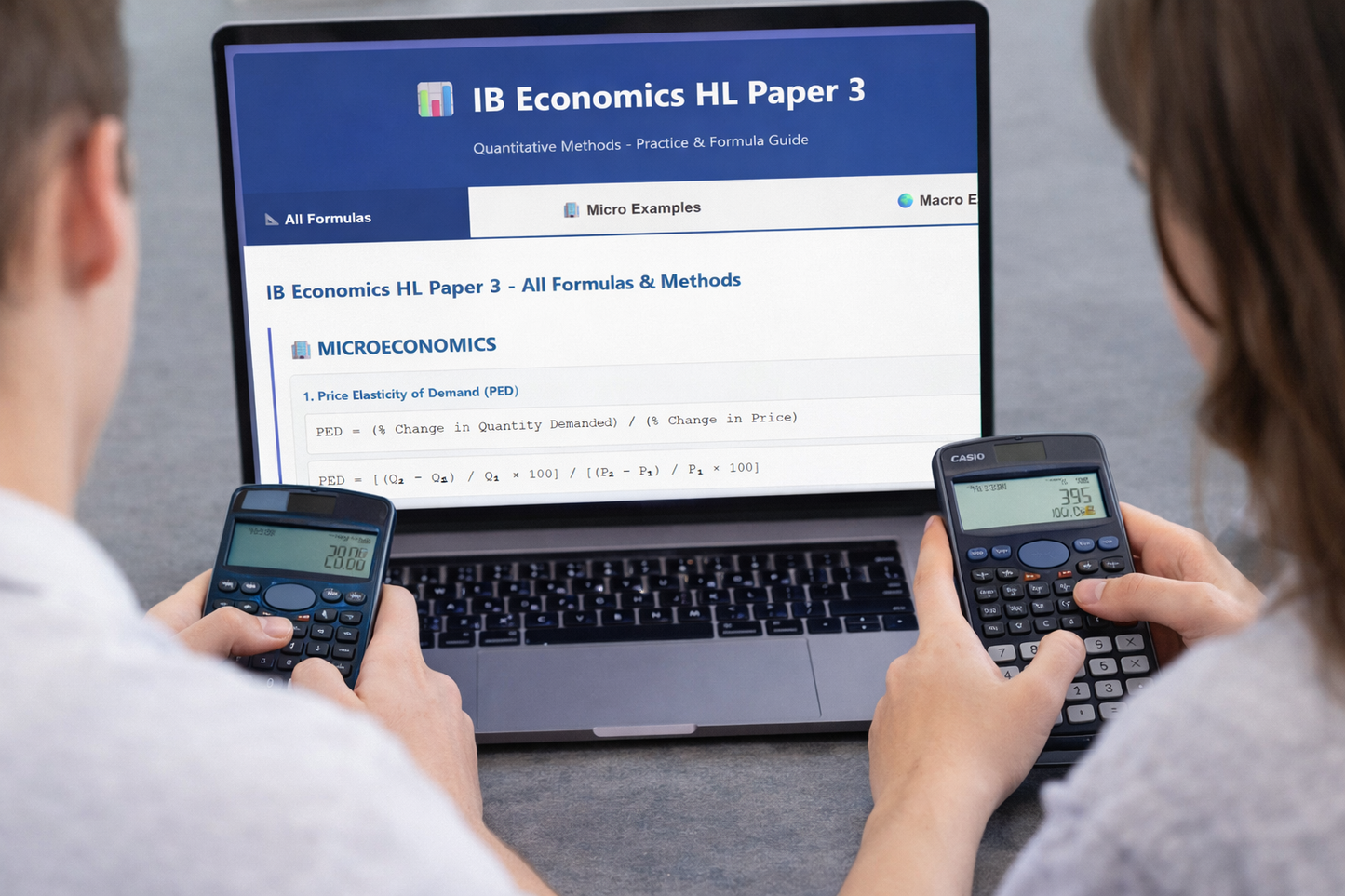
This IB Economics HL Paper 3 bundle provides a comprehensive set of interactive calculators, visualisers, and worked examples designed to support quantitative skills across microeconomics and macroeconomics, including elasticity, GDP, costs and revenues, PPF analysis, and simultaneous equations . It is specifically structured to mirror the demands of Paper 3, helping students practise method, accuracy, and interpretation under exam-style conditions.
IB Economics HL Paper 3 Guide (HTML)
This resource acts as a comprehensive quantitative methods handbook, bringing together all required IB HL Paper 3 formulas alongside fully worked microeconomic and macroeconomic examples. It is designed to reinforce exam technique by explicitly modelling how marks are awarded for method, accuracy, and interpretation. For teachers, it serves as a ready-made revision guide or flipped-learning resource, while students can use it independently to consolidate understanding, revise core calculations, and self-check their approach against exam-standard solutions
Simultaneous Equations in Economics (HTML)
The simultaneous equations guide walks students through deriving demand and supply equations, solving for equilibrium, and adjusting models to account for taxes and subsidies, all of which are core Paper 3 skills. Step-by-step explanations help learners bridge the gap between diagrams and algebra, a common source of difficulty at Higher Level. Teachers can use the resource to explicitly teach method and structure, while students benefit from a clear, repeatable framework that builds confidence in handling mathematically demanding market-equilibrium questions.
Production, Costs and Revenue Calculator (HTML)
This resource focuses on microeconomic calculations involving costs, revenues, profit, break-even analysis, and efficiency conditions such as MC = MR. It combines formula reference material with randomly generated scenarios and guided solutions, allowing students to practise interpreting firm-level data in a way that aligns closely with IB Paper 3 expectations. For teachers, it offers a flexible way to differentiate practice and demonstrate calculation logic, while learners gain repeated exposure to exam-style numerical reasoning with clear economic interpretations.
GDP Calculator (HTML)
The GDP Calculator supports students in calculating real GDP, GDP deflators, growth rates and GDP per capita using both raw data and index numbers, with embedded explanations of each formula. It is particularly well suited to Paper 3 macroeconomic questions where students must apply quantitative methods accurately and interpret outcomes. Teachers can use it to scaffold difficult calculations live, while learners benefit from immediate feedback, structured working, and repeated practice with randomly generated data.
Economics Elasticity Calculator (HTML)
This interactive elasticity calculator allows students to practise PED, PES, XED and YED using both standard calculations and more advanced reverse-engineering problems, closely reflecting the numerical demands of IB Economics HL Paper 3. Learners can input data, randomise values, and instantly see step-by-step working and interpretation, which supports method marks and accuracy. For teachers, it is an effective classroom demonstration tool for modelling exam technique, while also functioning as an independent practice resource that reduces marking load and builds student confidence with elasticity under timed conditions.
Macro PPF Visualiser (HTML)
The PPF visualiser allows learners to interact dynamically with production possibility frontiers, adjusting output combinations and observing changes in efficiency, opportunity cost, and economic growth. Scenario buttons enable exploration of shocks such as technological change or recessions, making abstract macroeconomic theory more concrete. Teachers can use the tool to support conceptual explanations and policy discussions, while students benefit from visual reinforcement of key ideas that frequently underpin Paper 3 data-response and calculation questions.
Share